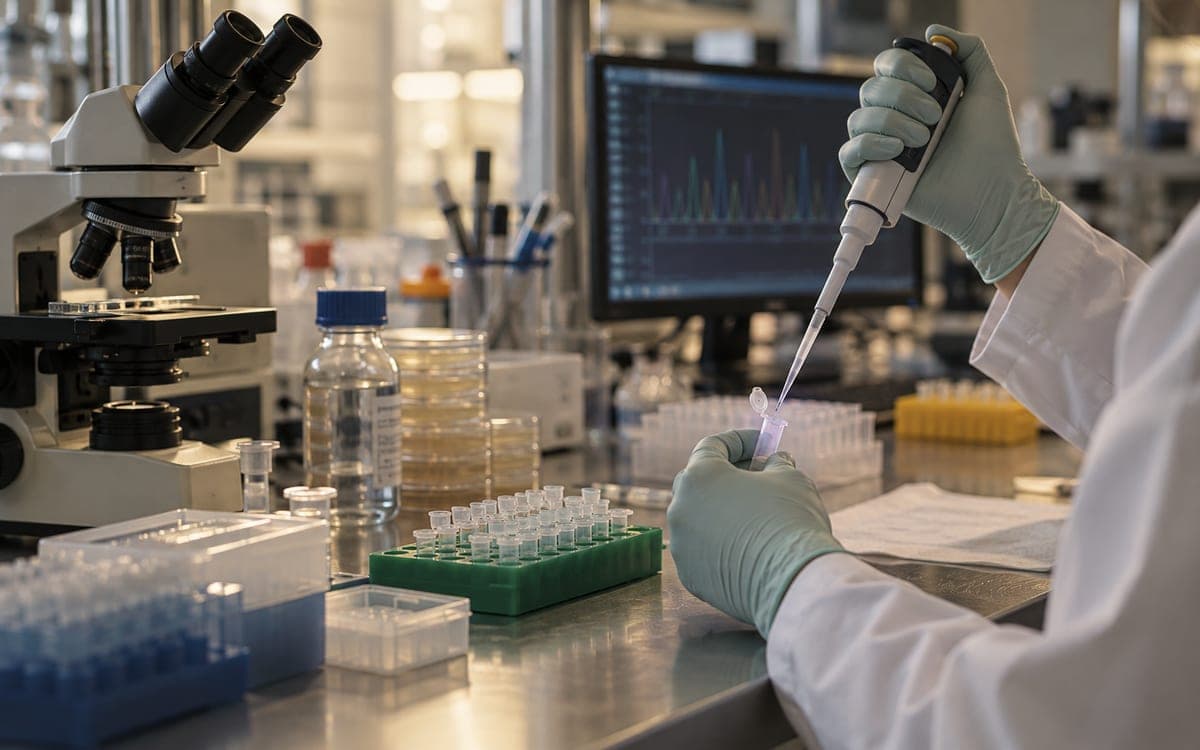
AlphaProtein Novo is a generative pipeline for enzyme design, not a diagnostic tool or an approved treatment. The useful distinction is between generating a candidate, predicting its structure and experimentally demonstrating its function. Readers considering the project should examine the exact artifact and its terms before interpreting a compelling molecular visualization as biological validation.
What the public implementation does
Google DeepMind’s repository describes a diffusion model that generates protein structures and sequences conditioned on a catalytic motif and ligand context. Optional stages include LigandMPNN sequence redesign, AlphaFold 3 structure prediction and evaluation metrics. The repository links a preprint with October 1 in its DOI. This article concerns that research pipeline; it does not report a new clinical trial, an approved product or a FyreLinkz laboratory experiment.
Code and weights have separate terms
Source code is Apache 2.0; the generator parameters and outputs have separate noncommercial terms. Those terms restrict use to noncommercial organizations or work on their behalf, exclude commercial research, and restrict parameter sharing. AlphaFold 3 and LigandMPNN keep separate conditions. Treat the workflow as multiple artifacts rather than assuming the code license settles everything. We have not granted permission for a particular application; review the exact terms and prohibited-use policy before obtaining or using the assets.
Read the evidence in layers
Our suggested reading worksheet has three columns: proposed design, computational evaluation and experimental observation. For each reported result, write down what was measured and which candidate it belongs to. A structural confidence score answers a different question from activity in an assay. If the publication includes laboratory results, trace those results to the tested subset rather than transferring success to every generated candidate. When communicating findings, preserve the original scope, conditions and uncertainty instead of implying that a design campaign proves a general therapeutic outcome.
Questions for a research team
Before adopting a design workflow, we would ask who defines the target reaction, how candidates are selected for review, and what evidence would reject a candidate. Keep identifiers consistent between generated artifacts and later measurements. Plan how an unsuccessful design is recorded, not only how a successful visualization is displayed. For a non-specialist reader, the most useful output is often a clear map of the experiment and its unresolved questions. Avoid using this project to make personal medical decisions or choosing a treatment.
What a responsible update would add
A future follow-up should identify the exact preprint version, artifact revisions and any independent reproduction. We would distinguish changes to the generation model from changes to selection or evaluation. Include negative results and resource use when available. An editorial article can explain why enzyme-design research matters without claiming that a molecule has reached deployment. Our current coverage is an interpretation of public sources; we have not downloaded parameters, generated biological candidates or performed assays. Readers seeking practical AI context can start with our weekly research index.
Frequently asked questions
Is AlphaProtein Novo a medical treatment?
No. This coverage concerns an enzyme-design research pipeline, not an approved treatment or diagnostic product.
Does Apache 2.0 cover every artifact?
No. The repository separates source code, parameter terms, output terms and dependency conditions.
Did FyreLinkz validate an enzyme?
No. We reviewed public documentation and did not run a design campaign or laboratory experiment.
Sources & further reading
Primary sources checked Oct 11, 2026. Vendor statements are attributed; editorial advice is our own.
- 1AlphaProtein Novo repository ↗Google DeepMind
- 2Designing enzymes for new-to-nature chemistry and non-natural substrates ↗AlphaProtein Novo authors / bioRxiv
- 3AP Novo parameters terms ↗Google DeepMind
- 4AP Novo outputs terms ↗Google DeepMind
Help us keep this useful. Check contact availability →

