DOE selected four national-lab robotics projects for award negotiations on October 8. The plans concern scientific automation, not demonstrated general-purpose autonomy. Selection does not guarantee an award.
What DOE announced—and what it did not
DOE selected projects led by Argonne, Brookhaven, Oak Ridge and SLAC. Their proposed testbeds address learning, reliability, connected experiments and scientific-facility operations. This is a development announcement. It does not establish that the selected systems have completed their proposed experiments. For readers, the distinction is practical: a research roadmap tells you what questions teams intend to investigate; an operating result needs methods, measurements and conditions that others can inspect.
Four projects tackle different links in the lab loop
MAESTRO targets reusable capabilities; DART targets reliability and transfer; TRACE targets connected, reproducible workflows; SPIRE targets photon-science operations. These names describe complementary research directions, not a ranking of autonomous robots. Our reading is that the important output would be reusable evaluation infrastructure. A striking demonstration can attract attention, but it becomes more useful when another team can repeat the task, diagnose a failure and explain which boundaries still require supervision.
Autonomy is a spectrum, not an on/off switch
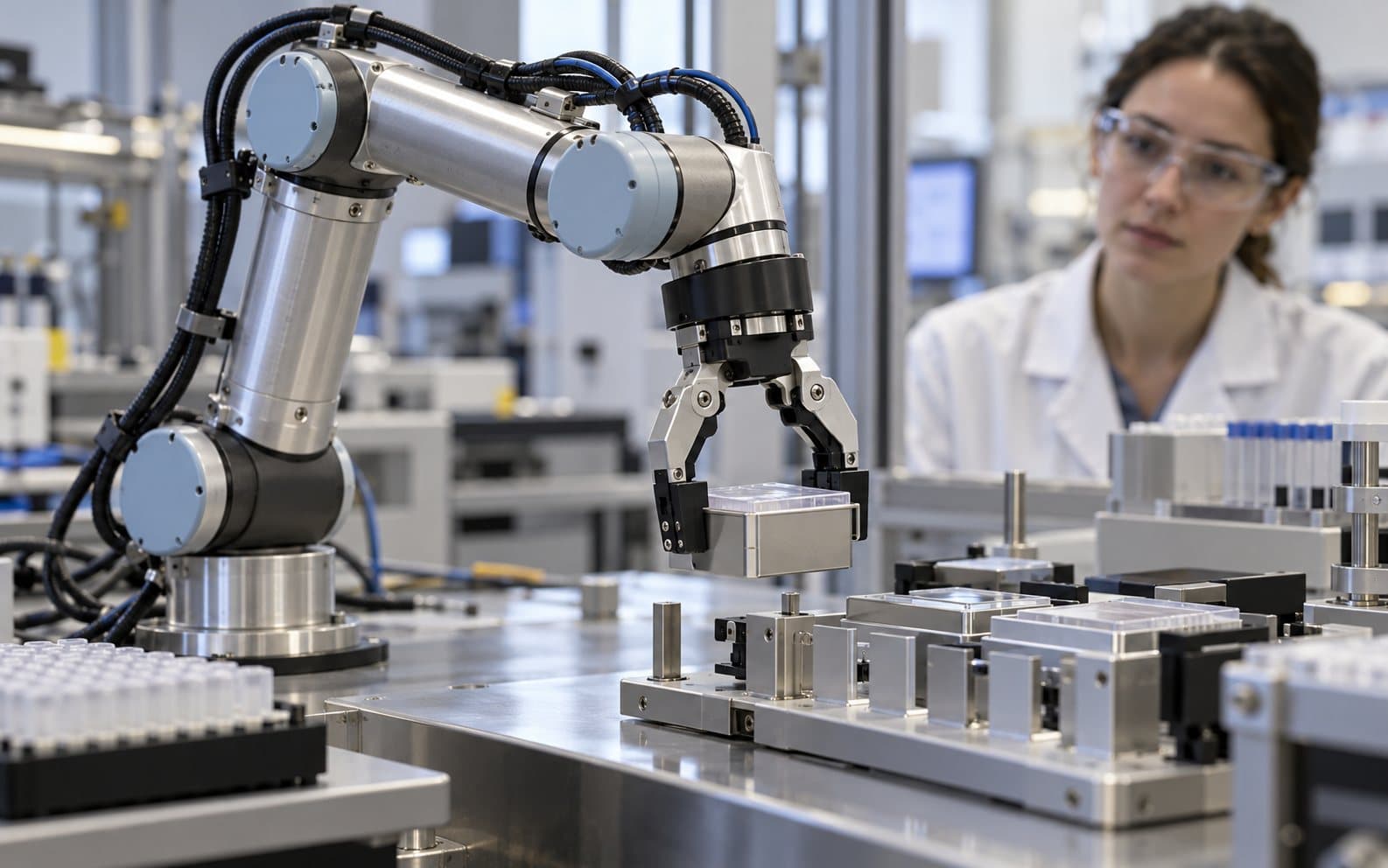
A robot repeating one carefully bounded movement is different from a system that interprets an experimental goal, chooses a measurement, changes instrument settings and checks whether the result is scientifically valid. SLAC’s SPIRE description makes that distinction explicit: existing equipment already performs constrained tasks such as mounting samples, while the new project proposes broader adaptation across varied samples and instruments. SLAC also reports earlier machine-learning and agent-assisted workflows at selected facilities, including beam tuning and monitoring; those examples are separate from the newly selected SPIRE program and retain researcher oversight. They show why headlines about a “self-driving lab” need specifics: what steps are automated, which safeguards remain, and who verifies the scientific conclusion?
The hard problem is trustworthy transfer
A robot can succeed in a clean simulation yet fail when sample shape, lighting, calibration or instrument behavior changes. A completed motion also does not prove that the sample was handled correctly or that the measurement answers the research question. DOE’s call specifically asks for benchmarkable, reproducible performance, including measures such as task success, time-to-result, provenance, reproducibility and how often a person must intervene. Provenance is more than a log: it helps reconstruct which model, calibration, sample and decision led to a measurement, making a failed result diagnosable. A meaningful benchmark should also count safe stops and recoveries, not only completed tasks. These are useful engineering targets, but they are not guarantees. Real progress will require published methods, clear failure reporting, safety boundaries, independent scrutiny and evidence that results hold across tasks and sites.
What to watch next
The program anticipates $30 million, with later support subject to appropriations. Its funding notice is a planning document, not evidence of completed systems. Next, look for award terms, evaluation protocols and results that identify the robot, instrument, software version, sample conditions and failure rate. Our suggested reading checklist asks three questions: did another facility reproduce the workflow, were unsuccessful attempts counted, and could an operator stop or recover the system safely? Keep those questions separate from predictions about household robots. A scientific testbed and a general-purpose home assistant face different tasks and constraints. The useful future of robotics is one supported by inspectable performance, not a forecast inferred from a funding headline.
Frequently asked questions
What are the four DOE autonomous-science robotics projects?
The projects are MAESTRO at Argonne, DART at Brookhaven, TRACE at Oak Ridge and SPIRE at SLAC.
Has DOE funded the four projects already?
Selection starts award negotiations and does not guarantee an award. Future program funding depends on appropriations.
Can these robots run scientific labs without people?
No. These proposed scientific testbeds still need evaluation.
How will researchers know whether lab robots are reliable?
DOE’s solicitation calls for reproducible benchmarks and measures such as task success, time-to-result, provenance, repeatability and human-intervention rates. Cross-task and cross-site tests can reveal whether a system works beyond its original demonstration.
Sources & further reading
Primary sources checked Oct 9, 2026. Vendor statements are attributed; editorial advice is our own.
- 1DOE Announces Four National Laboratory-Led Selections to Advance Robotics and Automation for Autonomous Scientific Discovery ↗U.S. Department of Energy, Office of Science · Oct 8, 2026
- 2SLAC leads new project to build the self-driving laboratory of the future ↗SLAC National Accelerator Laboratory · Oct 8, 2026
- 3Robotics and Automation Testbeds for Autonomous Scientific Discovery (LAB 26-3601) ↗U.S. Department of Energy, Office of Science · May 14, 2026
Help us keep this useful. Check contact availability →