The October 5–11 updates span interactive ChatGPT answers, lower-cost hosted inference, local embeddings and visual research models. They have different access and license conditions. Below, dated developments are separated from older research, and vendor or author results are not presented as FyreLinkz benchmarks.
What changed this week? A dated release checklist
This edition covers October 5–11, 2026 and checks the supplied project leads against primary sources. A paper date, code release and product rollout are different events. Nine entries below have a dated development in that window; nine older or incompletely dated research items follow in a separate watchlist. Availability and pricing can change after publication.
| Development | Dated event | What to check first |
|---|---|---|
| GPT-6 Intelligent UI | Oct 7: ChatGPT rollout announcement | Account rollout; Chat scope |
| Claude Haiku 5.5 | Oct 7: model announcement | Prompt-length pricing tier |
| EmbeddingGemma 2 | Oct 6: Google launch post | Encoder configuration and retrieval quality |
| WorldPlay2 | Oct 6: weights/code; Oct 7: Reactor integration | GPU setup and noncommercial terms |
| Kandinsky 6.0 Video | Oct 6: lab code/checkpoint release | Lite versus Pro, offload and dependencies |
| Nano Banana 2.1 | Oct 6: dated model card | Hosted access; conflicting lineage descriptions |
| Iris-3B | Oct 7: research preprint | Separate text encoder and full memory footprint |
| GenIA | Oct 8: research preprint | Noncommercial terms and gated dependency |
| OpenAI mathematics | Oct 6: release post; Oct 7: corrections | Verification and withdrawal history |
GPT-6 Intelligent UI: a ChatGPT interface update
OpenAI's October 7 announcement adds interactive response formats to ChatGPT Chat: graphics, buttons, forms and charts can accompany text. Rollout began with paid tiers, followed by Free and Go; workplace settings can affect access. The announcement explicitly leaves Work and Codex model versions unchanged. Our practical test suggestion is to check whether a generated calculator or comparison exposes its assumptions and handles changed inputs correctly. An interactive answer is not automatically a verified application.
Haiku 5.5 pricing: count input, output and prompt length
Anthropic positions Haiku 5.5 for narrow, high-volume tasks. Its launch pricing has two prompt-length tiers, shown below in US dollars per million tokens. The illustrative totals assume one million uncached input tokens and one million output tokens accumulated across requests that all fall in the stated tier; they are arithmetic, not a provider quote. Cache charges, taxes and other service costs are excluded. Compare cost per accepted task after retries and human correction, rather than relying on a blanket percentage-saving claim.
| Prompt length per request | Input / output per million tokens | Illustrative 1M input + 1M output |
|---|---|---|
| Up to 100,000 tokens | $0.10 / $0.50 | $0.60 |
| Over 100,000 tokens | $0.50 / $2.50 | $3.00 |
EmbeddingGemma 2: retrieval, not a chatbot
Google's 740-million-parameter model puts text, image, audio and video representations in a shared embedding space. Google lists Apache 2.0 licensing and an 8K-token context. It reports quantized active-RAM figures of about 191 MB for text-only weights and 567 MB for the full multimodal model on a Pixel 11 Pro. Those numbers describe Google's configuration, not every device's complete application footprint. For a useful trial, measure whether the correct item appears in your top search results before comparing storage or latency. Our vector database comparison guide separates retrieval quality from infrastructure choices.
WorldPlay2 and Kandinsky 6: different visual-AI jobs
WorldPlay2 is an interactive world-model project. Its repository dates weights and inference code to October 6 and Reactor integration to October 7. It requires CUDA/NVIDIA infrastructure; launchers default to eight GPUs but document a single-GPU path, while the Reactor preset uses four B200s. No general consumer-VRAM minimum is established. Its CC BY-NC terms and underlying model dependencies matter for commercial work. Kandinsky 6.0 Video instead targets synchronized video and audio generation, with Lite and Pro variants. The lab dates its MIT code/checkpoint release to October 6. Its Pro setup example uses CPU offload with an 80GB GPU; that is not a minimum specification or evidence that every consumer setup works. For a creator, the useful comparison is an accepted shot or controlled interaction under one exact configuration, not a parameter-count ranking. Start with our video-tool comparison checklist.
Nano Banana 2.1: hosted image generation with a documentation caveat
Google's dated model card describes an image-generation and editing service offered through its products. The API identifier is gemini-nano-banana-2.1; public local weights were not found in the reviewed sources. Google's pages disagree on lineage: the API documentation refers to Gemini 3.1 Flash Image, while the model card refers to Gemini 3.6 Flash. We leave that discrepancy visible instead of selecting a lineage. Hosted use does not require your own inference GPU. Check current account access, prices and output rights before building a workflow around it; we have not independently tested its image quality.
Iris-3B: pixel-space generation still has dependencies
Speridlabs' October 7 preprint describes a 3B flow-matching image model that generates RGB pixels without a VAE, with related depth and restoration fine-tunes. Code and weights are linked publicly under Apache 2.0. The deployment also uses a separate Qwen3-VL-4B-Instruct text encoder, so '3B' is not the complete system size. The project's comparison figures use reported evaluation conditions rather than one uniform independent test of every model. Neither parameter count nor a sample gallery establishes your GPU memory requirement. Log the full pipeline, resolution and peak memory before buying hardware.
GenIA: reconstruction access is not the same as unrestricted use
GenIA's October 8 paper studies generative 3D reconstruction with test-time input alignment. Its implementation requires CUDA/NVIDIA setup and separately gated SAM 3D Objects weights. GenIA is CC BY-NC 4.0, with additional dependency terms. A repository link therefore does not make every component commercially usable. For a trial, distinguish reconstruction quality from setup time, dependency access and whether your intended output use is allowed.
OpenAI mathematics: read corrections as well as results
OpenAI's October 6 mathematics release includes model-produced research material and some formalizations at different verification stages. Its repository history on October 7 records three withdrawn manuscripts after a sign error invalidated an argument and affected dependent work, alongside other revisions. This is evidence of an ongoing checking process, not proof that every released manuscript is correct. Read the exact version, formalization status and correction history before describing a result as a solved problem. We have not independently checked these proofs.
Research watch: older papers and dates that need qualification
These supplied leads are relevant, but the reviewed evidence does not make them all new October 5–11 launches. Paper dates below identify the primary artifact; a later repository edit is not automatically a new research release. In particular, computational biology and materials findings should not be described as clinical or device validation.
| Research lead | Date or release status | What it actually adds; main limit |
|---|---|---|
| MSFlow / MotionSpaceFlow | Sep 28 preprint | Text-conditioned human motion, not video generation. Implementation/checkpoints linked; benchmark and memory claims require reproduction. |
| Amazon ALoDLM-8B | Oct 3 preprint | Adaptive recurrence in diffusion language models. Noncommercial terms; B200 throughput does not establish consumer-GPU speed. |
| AlphaProtein Novo | Oct 1 in cited preprint DOI | Computational enzyme-design pipeline. Code, parameters and outputs have separate terms; no clinical benefit inferred. |
| BOTANIC-1 with Gemma 4 | Story date not displayed; cited preprint DOI Sep 4 | Plant-variant prioritization with retrospective evidence. Scientist follow-up remains necessary; no crop-yield trial inferred. |
| Room-temperature magnetic semiconductor candidates | Oct 4 Vals post | New computational property predictions. One candidate was synthesized in 1999, but the newly discussed semiconductor properties remain unmeasured. |
| FlashDexRetarget | Oct 1 preprint; revised Oct 4 | Multi-motion dexterous retargeting. Project access and code/license unresolved in this audit; paper results are not universal robot reliability. |
| TERRA | Sep 29 preprint | Terrain-aware musculoskeletal simulation. Parkour examples use specialized fine-tuning; no clinical or physical-robot validation inferred. |
| CoDimRecon | Sep 28 preprint; revised Oct 3 | Reconstructs simulation-ready rigid and deformable objects. Effective simulation parameters are not measured material properties; code marked soon. |
| DistScene | Oct 3 preprint | Compositional object/environment generation. Project marks code, checkpoints and dataset as coming soon. |
A useful first experiment, without buying the wrong GPU
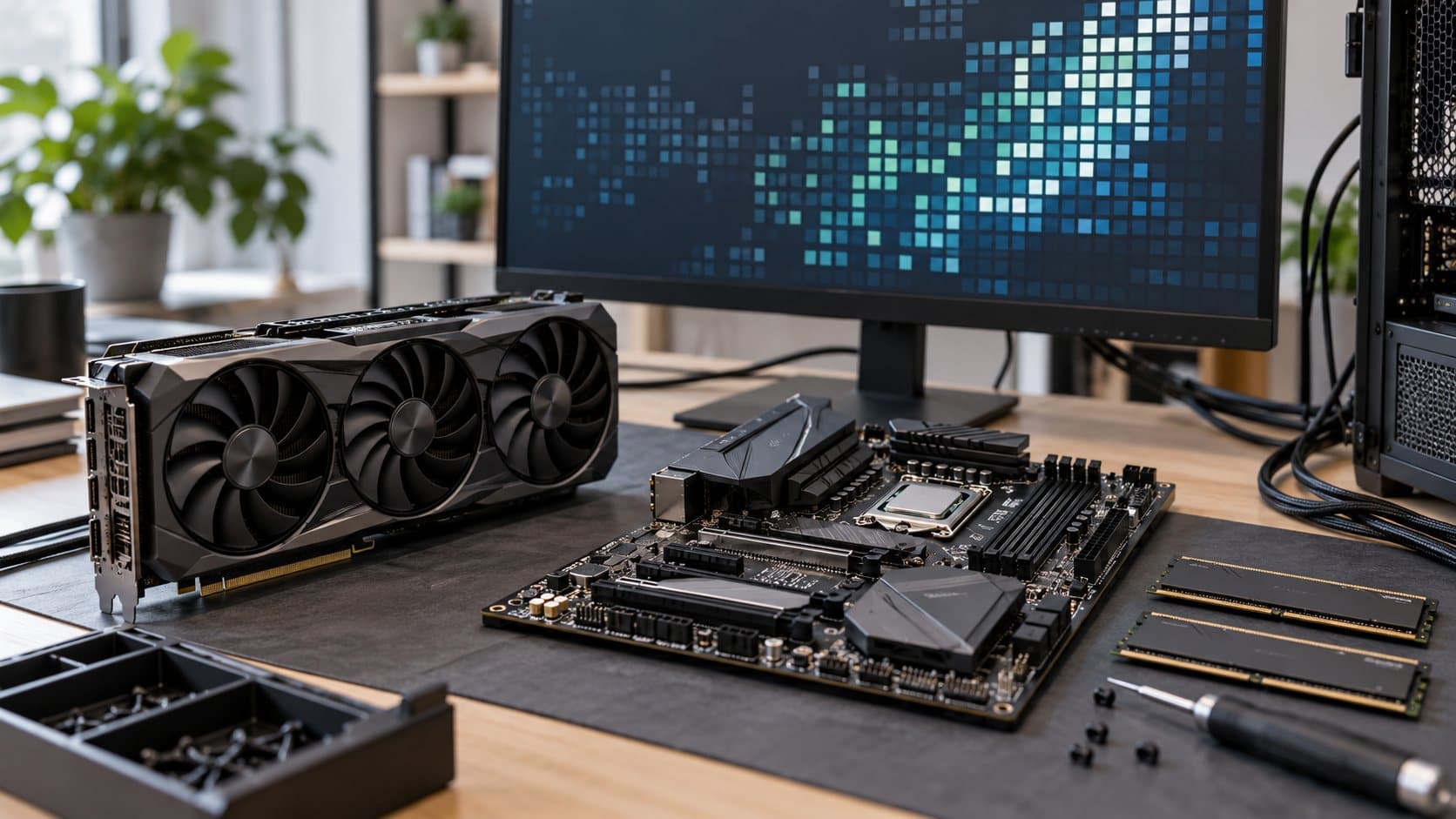
Our editorial recommendation is to pick one task and define a pass condition before testing. For hosted models, save the exact model ID, prompt length, billed token totals, rejected outputs and correction time. For local models, save the complete component list, license, runtime, resolution or context, peak RAM/VRAM and failures. A launch post or attractive gallery cannot answer all of those questions. Use the hardware planner for dated regional examples and the RTX 4050 local-model guide for memory checks. Those tools do not certify fit for every new research model.
- Freeze the model/version and write representative success and failure cases.
- Check rights for code, weights, encoders, datasets and outputs separately.
- Measure accepted results and total correction effort; keep unsuccessful runs.
- For research claims, distinguish author evaluation, independent reproduction and real-world validation.
Frequently asked questions
Which AI developments are dated October 5–11, 2026?
The reviewed sources date GPT-6 Intelligent UI, Haiku 5.5, EmbeddingGemma 2, WorldPlay2 code/weights, Kandinsky 6 code/checkpoints, Nano Banana 2.1's model card, Iris-3B, GenIA and OpenAI's mathematics release or corrections to that window. The article distinguishes product rollouts, artifact releases and research submissions.
How much does Claude Haiku 5.5 cost?
Anthropic's published rates are $0.10 input and $0.50 output per million tokens for prompts up to 100,000 tokens; above that prompt length, $0.50 input and $2.50 output. Cache charges and other costs are separate. Check current pricing before budgeting.
Can WorldPlay2 run on one consumer GPU?
The repository documents a single-GPU execution path, but that does not establish that an arbitrary consumer card has enough memory or useful speed. Its launchers default to multiple GPUs and the Reactor preset uses four B200 GPUs. No general minimum VRAM is claimed here.
Are all these models commercially usable open source?
No. Hosted services, noncommercial research licenses, gated dependencies and not-yet-released checkpoints all appear in this list. Check the exact code, weight, dataset, dependency and output terms for the artifact you plan to use.
Is EmbeddingGemma 2 a generative chatbot?
No. It maps supported inputs into embeddings for search and retrieval. A system that generates answers needs additional components and its own retrieval-quality evaluation.
Do these research papers prove medical or materials breakthroughs?
A computational prediction, retrospective evaluation or simulated interaction does not by itself establish clinical benefit, field performance or a validated device. This roundup attributes reported findings and keeps their experimental limits visible.
Sources & further reading
Primary sources checked Oct 11, 2026. Vendor statements are attributed; editorial advice is our own.
- 1GPT-6 and Intelligent UI for everyone ↗OpenAI · Oct 7, 2026
- 2Introducing Claude Haiku 5.5 ↗Anthropic · Oct 7, 2026
- 3EmbeddingGemma 2: an open, lightweight multimodal embedding model ↗Google DeepMind · Oct 6, 2026
- 4Official WorldPlay2 release notes, inference and license ↗WorldPlay2 authors
- 5Kandinsky 6.0 Video implementation and model links ↗Kandinsky Lab
- 6Official lab release announcements ↗Kandinsky Lab
- 7Nano Banana 2.1 model card ↗Google DeepMind
- 8Gemini Nano Banana 2.1 API model documentation ↗Google AI for Developers
- 9
- 10Iris-3B model card and dependencies ↗Speridlabs — Hugging Face
- 11GenIA implementation, setup and license ↗Meta research authors
- 12Generative Reconstruction with Test-Time Input Alignment ↗GenIA authors — arXiv · Oct 8, 2026
- 13Sharing AI progress in mathematics ↗OpenAI · Oct 6, 2026
- 14
- 15MSFlow project page ↗MotionSpaceFlow authors
- 16MotionSpaceFlow research paper ↗MotionSpaceFlow authors — arXiv · Sep 28, 2026
- 17ALoDLM-8B model card ↗Amazon — Hugging Face
- 18Adaptively Looped Diffusion Language Models ↗ALoDLM authors — arXiv · Oct 3, 2026
- 19AlphaProtein Novo official repository and terms ↗Google DeepMind
- 20Designing enzymes with AlphaProtein Novo ↗AlphaProtein Novo authors — bioRxiv
- 21
- 22Two Room-Temperature Antiferromagnetic Semiconductor Candidates ↗Vals AI · Oct 4, 2026
- 23Multi-Motion Retargeting research paper ↗FlashDexRetarget authors — arXiv · Oct 1, 2026
- 24Terrain-aware musculoskeletal locomotion project ↗EPFL TERRA researchers
- 25Terrain-Aware Reconstruction, Retargeting and Control for Musculoskeletal Locomotion ↗TERRA authors — arXiv · Sep 29, 2026
- 26Simulation-ready scene reconstruction project ↗CoDimRecon authors
- 27Agentic Reconstruction of Sim-Ready 3D Scenes ↗CoDimRecon authors — arXiv · Sep 28, 2026
- 28Object-to-scene distillation project and release status ↗DistScene authors
- 29Object-to-Scene Distillation for 3D Scene Generation ↗DistScene authors — arXiv · Oct 3, 2026
- 30Iris-3B pixel-space diffusion preprint ↗Speridlabs authors — arXiv · Oct 7, 2026
- 31Plant-genome research linked by Google DeepMind ↗Living Models researchers — bioRxiv
Help us keep this useful. Check contact availability →