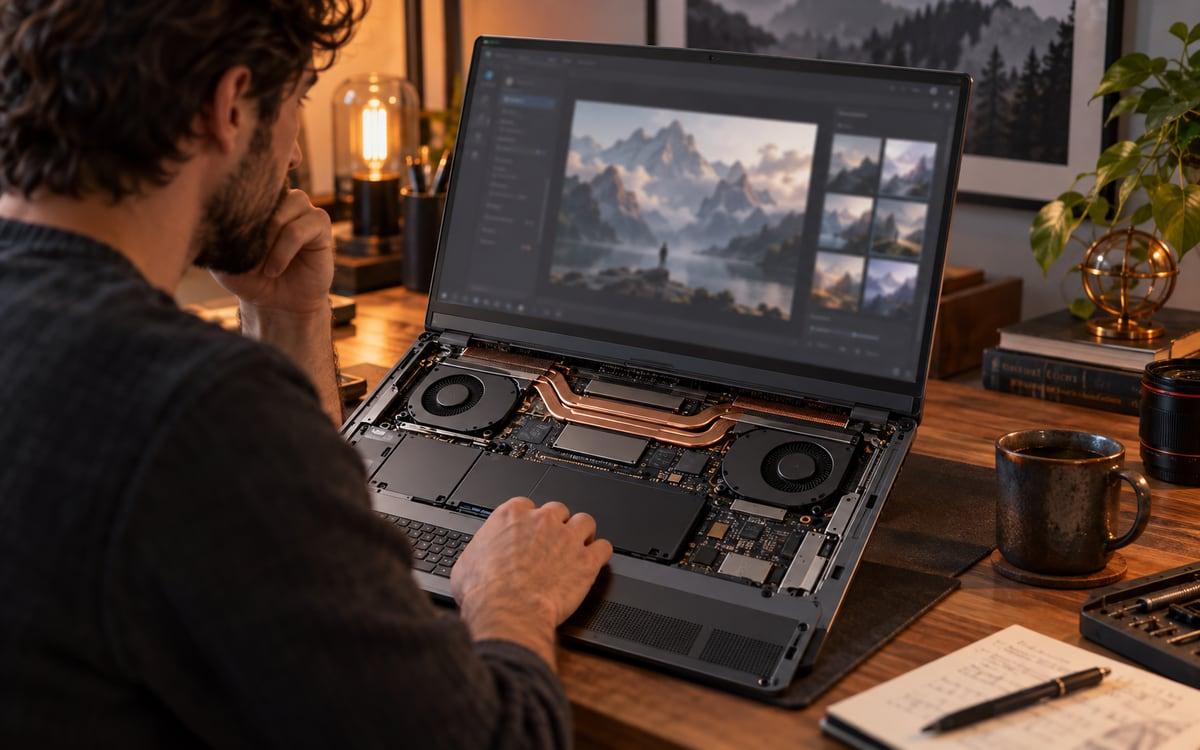
NVIDIA says RTX Spark laptops launch October 16, with configurations offering up to 128GB unified memory. That capacity is a reason to investigate larger local models, not proof of fast inference. Before buying, verify your exact model, runtime, sustained performance and the configuration actually being sold.
What NVIDIA has announced—and what is still a buying question
NVIDIA's October 7 announcement gives an October 16 laptop availability date and November timing for compact desktops. Its October 13 software update describes ecosystem readiness. These are vendor announcements ahead of the laptop launch, not our review of a shipping retail system. We have not tested RTX Spark. Confirm delivery dates, regional stock and the specification of the exact device you are considering.
Unified memory: capacity is only the first check
Our recommendation is to separate three questions: will the workload fit, will the runtime support it, and will it finish quickly enough? A memory figure cannot answer all three. Leave room for the operating system, application buffers and context growth. Ask for a demonstration using the intended model and quantization, rather than a smaller model presented under a similar family name.
| Buying question | Useful evidence | Weak substitute |
|---|---|---|
| Will my workload fit? | Peak memory for the full workflow | Weight-file size alone |
| Will it run? | Exact runtime and dependency versions | A broad compatibility logo |
| Is it fast enough? | Repeated tasks at the chosen settings | Peak compute specification |
| Is it portable? | Measured battery use for that workload | An idle battery-life claim |
Software readiness is workload-specific
NVIDIA lists tools including PyTorch, Python and CUDA among the supported developer stack. Treat that as a starting point for checking your own dependencies. A Python application may also rely on compiled extensions, particular wheels, plugins or external services. Save the version list and installation instructions that produced the demonstration. Avoid assuming a successful chat-model run proves an entire video workflow is ready.
Ask for sustained tests, not a single impressive response
For your own comparison, repeat a representative task several times and record warm-up, time to first output, total completion time and failures. Use the same prompt or input asset, output size and acceptance criteria on the alternatives. Watch for quality changes hidden behind a speed claim. If you need quiet operation or battery use, request those measurements under load. These are suggested evaluation methods, not measurements we have collected.
- Name the model, quantization, runtime and context length.
- Record the complete workload, including encoders and post-processing.
- Check whether cloud calls are still required.
- Compare actual retailer configurations and return terms.
When waiting is the cheaper decision
If your current system already finishes the work within your budget, a launch is not a reason to replace it. Keep a list of jobs that genuinely fail because of memory or latency, then evaluate a new machine against that list. Start with our workload-first workstation guide and local-versus-cloud cost worksheet. Regional prices, tax and warranty can change the decision; this article does not provide verified retailer quotes.
Frequently asked questions
When are RTX Spark laptops due?
NVIDIA announced October 16, 2026 availability. Check regional retailers and the exact configuration; an announced date is not a stock guarantee.
Does 128GB unified memory guarantee fast AI?
No. Capacity, runtime compatibility, sustained speed and output quality are separate questions.
Has FyreLinkz reviewed RTX Spark hardware?
No. This is a source-based buying checklist, not a hands-on hardware review.
Sources & further reading
Primary sources checked Oct 14, 2026. Vendor statements are attributed; editorial advice is our own.
- 1RTX Spark and Microsoft Windows announcement ↗NVIDIA · Oct 7, 2026
- 2RTX Spark software ecosystem updates ↗NVIDIA · Oct 13, 2026
Help us keep this useful. Check contact availability →