The short answer: start with the runtime
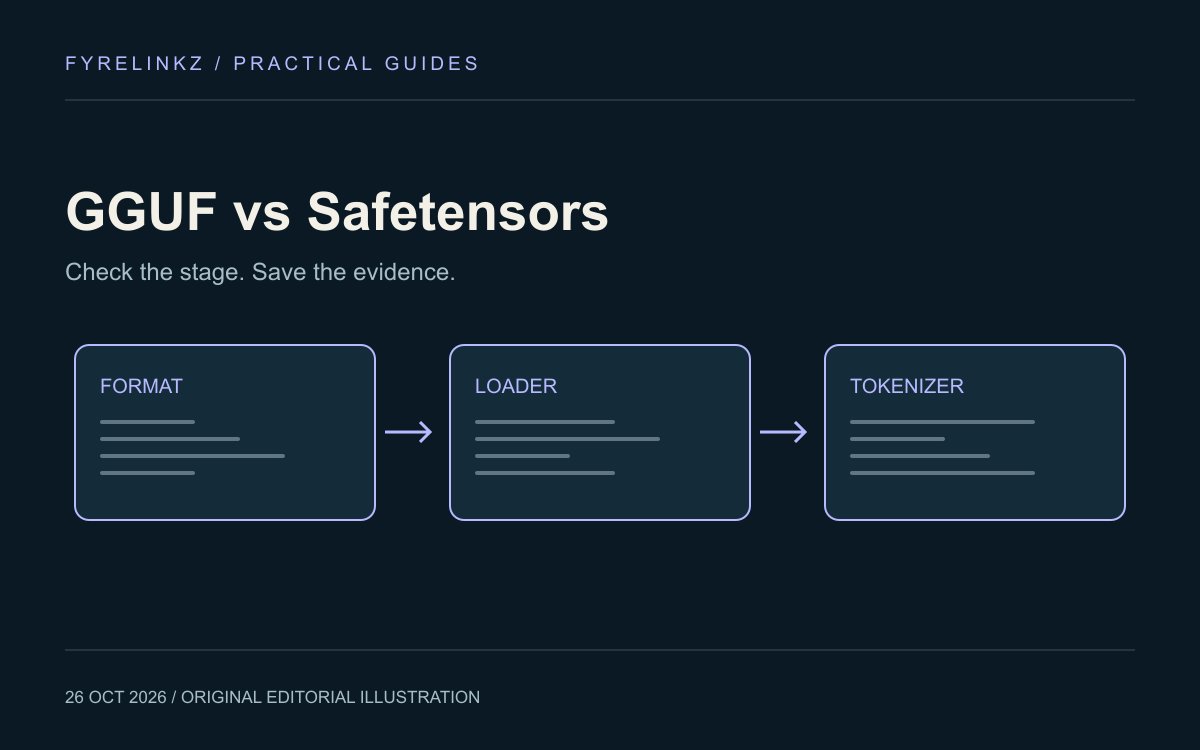
GGUF specifies tensor data together with structured metadata, including architecture and quantization information. Safetensors is a tensor serialization format designed to avoid pickle's arbitrary-code-execution behavior. Those are different packaging choices, not a leaderboard. A runtime still needs to implement the model's architecture and understand the surrounding configuration.
Separate four decisions that file names blur
Write down the model identity, the numeric representation, the container and the runtime. Changing one does not automatically change the others. Two files with similar names may encode different revisions or quantization schemes; two files in different containers may still represent closely related weights.
| Decision | Question to answer | Insufficient shortcut |
|---|---|---|
| Architecture | Does this runtime implement this model? | The filename ends in .gguf |
| Precision or quantization | Which representation and conversion were used? | The file is smaller |
| Packaging | Which companion files and metadata are needed? | One download completed |
| Runtime | Which loader and version are documented? | Another model opened in this app |
A file extension does not guarantee compatibility
Use the exact artifact recommended by the project's current instructions. Check the architecture, tokenizer and any extra code or components it requires. Carbon-X offers a concrete exception to generic format advice: its current card says llama.cpp and GGUF runtimes are unsupported because they cannot load its custom Python DNA tokenizer. A general suggestion to download every model in GGUF would fail for that documented case.
Compare representations without inventing a winner
If both artifacts are documented as supported, test the same prompt, settings and required output. Record the exact revision and converter when known. Inspect correctness before comparing load time or memory. A comparison with different templates, context lengths or output budgets cannot cleanly attribute the difference to the container. Do not assume a lower bit count preserves the capability your task depends on. This article reports no independent format benchmark.
Check the whole download and its terms
Read the model card and enumerate required tokenizer, configuration, encoder, decoder and adapter files for that workflow. A complete package may involve several artifacts. Then check license terms for the weights and any bundled code separately. Neither a format extension nor a repository's popularity establishes commercial-use permission. Verify available storage and a feasible memory plan before spending time on a large download.
Safer serialization is not a complete security review
Safetensors' format addresses a particular loading risk associated with pickle; it does not make every surrounding installer, custom node or remote-code dependency trustworthy. Keep software updated, use the publisher's distribution route and inspect code before granting it execution. Avoid converting an unfamiliar bundle merely to make its filename look compatible. Our model download safety checklist separates weight storage from executable components.
From a compatible file to a working model
Once the documented baseline loads, inspect runtime allocation using the Ollama context and memory guide, or use the ComfyUI error-by-stage guide for image workflows. Record the file identity in the memory log. Compatibility is the first gate; quality, speed and operating cost remain separate evaluations.
Frequently asked questions
Is GGUF always better than Safetensors?
No. Choose the format and artifact supported by the exact model and runtime, then evaluate the task you need.
Does changing the extension convert a model?
No. A real conversion must handle tensor layout, metadata, architecture and any tokenizer requirements; renaming does not do that.
Does Safetensors make an entire model package safe?
No. It addresses tensor serialization risks, while executable dependencies, custom code and loaders require separate review.
Can a GGUF model still fail to fit my GPU?
Yes. Quantization, context, runtime buffers and other workloads affect memory independently of the extension.
Sources & further reading
Primary sources checked Oct 26, 2026. Vendor statements are attributed; editorial advice is our own.
- 1
- 2
- 3Carbon-X model card: tokenizer runtime limitations ↗HuggingFaceBio
Help us keep this useful. Report a factual correction →