What Tencent released
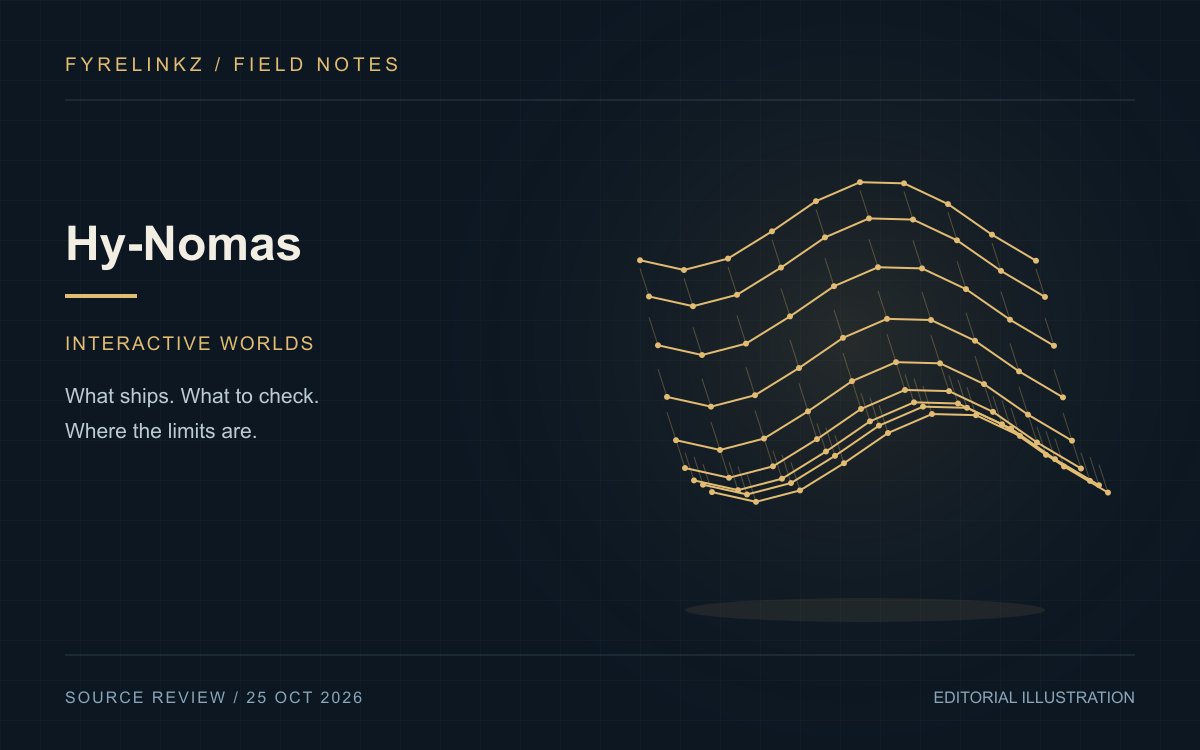
Hy-Nomas is an interactive video world-generation project with multi-turn prompts and camera control. Its repository includes training, inference, a demo and data-preparation code. Downloadable assets include generation checkpoints, decoders, adapters and a prompt-enhancement component rather than one self-contained file. Segment-wise generation retains history; the low-memory configuration instead bounds retained context.
A camera move tests more than a beautiful frame
Our proposed trial starts with a simple room and three recognizable objects. Move past one object, turn away, then return. Compare its position, shape and relationship to the others. Repeat the instruction sequence across runs and retain failures. This tests the intended navigation task. A coherent opening frame cannot establish persistent memory, and a convincing camera turn cannot prove the scene remains consistent after several turns.
Map dependencies before downloading
Tencent recommends a packaged Docker environment on a compatible Linux/NVIDIA host and documents a manual CUDA setup. A single-RTX-4090 low-memory configuration uses quantized components and a sliding history window. Treat that as a publisher-documented path, not an independently measured minimum. Preserve model directory structure and match every configured artifact path; a missing decoder cannot be repaired by rewriting a prompt.
Separate control, consistency and throughput
Control means a requested movement or world change happens. Consistency means existing details survive that change. Throughput means the configured machine produces usable segments at the required pace. Record generation, decoding and queue time separately. A fast generator can still feel unresponsive if decoding stalls. Keep accepted and rejected turns, then judge the complete session rather than presenting its strongest isolated segment.
Fine-tuning and a web demo are different workloads
Do not estimate training feasibility from one inference run. Reproduce a documented inference path first, confirming expected files and outputs. A hosted demonstration also needs session limits, memory accounting and recovery after a failed turn. Use non-sensitive test uploads and inspect server logging. Set a fixed session budget before exposing the interface. A research demo does not become a reliable public service simply because its port is reachable.
License and evaluation limits
The repository identifies Apache-2.0 for Hy-Nomas and retains applicable third-party terms. Check those dependencies before redistributing a bundle. No hardware or performance result here is a FyreLinkz measurement. Use the supplied configuration as a reproducible starting point and publish actual settings alongside future comparisons. Report which history limits were used, because bounding memory can change the very consistency behavior that the evaluation is meant to examine.
Keep a session ledger
A session record should pair each instruction with the preceding state, the returned segment and a short human assessment. Mark whether the user asked for camera motion or a change to world contents; otherwise a model might appear responsive while solving a different problem. If a retry restarts history, label it as a new session. This simple ledger makes a later comparison more informative than a montage that hides abandoned turns.
Frequently asked questions
Does Hy-Nomas support camera control?
Yes. Tencent documents camera-controlled generation alongside multi-turn text prompts.
Will it run on any laptop GPU?
That is not established. The repository documents a specific RTX 4090 low-memory configuration.
Does inference feasibility prove training feasibility?
No. Training, inference and a multi-user demo need separate memory and throughput assessments.
Sources & further reading
Primary sources checked Oct 25, 2026. Vendor statements are attributed; editorial advice is our own.
- 1Hy-Nomas project website ↗Tencent
- 2Hy-Nomas source and deployment documentation ↗Tencent Hunyuan
Help us keep this useful. Report a factual correction →