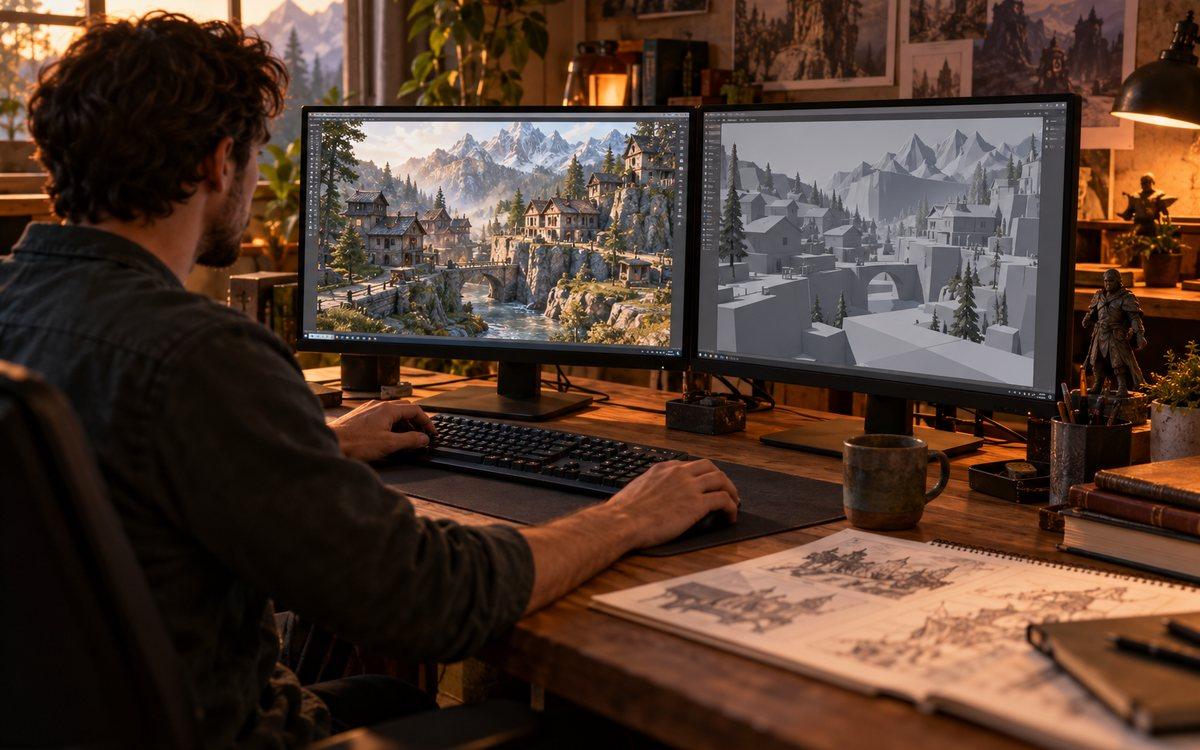
UniForge3D combines reconstruction and shape generation in a shared coordinate system. Treat unseen surfaces as inferred completion, even when the finished asset looks plausible.
What UniForge3D actually reports
The project uses an anchor-guided space to connect reconstruction and generation branches. It predicts point maps and a complete sparse structure, then selects informative input views for individual voxels. Its stated goal is to preserve observed detail while completing regions absent from the images.
What this changes for the reader
A clean model can hide an important distinction: some surfaces are constrained by photographs, others are generated from learned priors. Our editorial recommendation is to label that distinction in asset review. For a decorative object, plausible completion may be enough; for dimensions or manufacturing references, visual plausibility is not a measurement.
A practical evaluation before adoption
Photograph a permitted object from a few views and keep another view for inspection. Compare silhouette, visible markings and rear-side structure against that held-out image. Add one more input view and see whether the inferred region changes. Keep camera setup, crop choices and input count in the review log.
- Separate observed geometry from generated completion.
- Compare with a held-out view.
- Check scale, topology and export suitability independently.
Limits and availability to keep in view
Author-reported benchmark leadership is not a FyreLinkz measurement. We have not verified a complete inference environment, hardware floor or downstream asset compatibility. Read the current code and asset terms before adopting the pipeline.
Where to go next
Read our image preservation and output review for the adjacent workflow decision. Keep this project's conditions separate from other models' results. If a dependency, artifact or service limit is unclear, leave it unresolved in the comparison rather than filling the gap with an assumption.
Frequently asked questions
What problem does UniForge3D address?
It connects sparse-view reconstruction with complete-shape generation in an anchor-guided space.
Are unseen surfaces verified measurements?
No. Generated completion should not be treated as observed geometry.
Has FyreLinkz independently tested UniForge3D?
No. This article reports the linked primary source and proposes an editorial evaluation; it contains no independent performance benchmark.
Sources & further reading
Primary sources checked Oct 18, 2026. Vendor statements are attributed; editorial advice is our own.
- 1UniForge3D — primary source and release details ↗UniForge3D project
Help us keep this useful. Check contact availability →