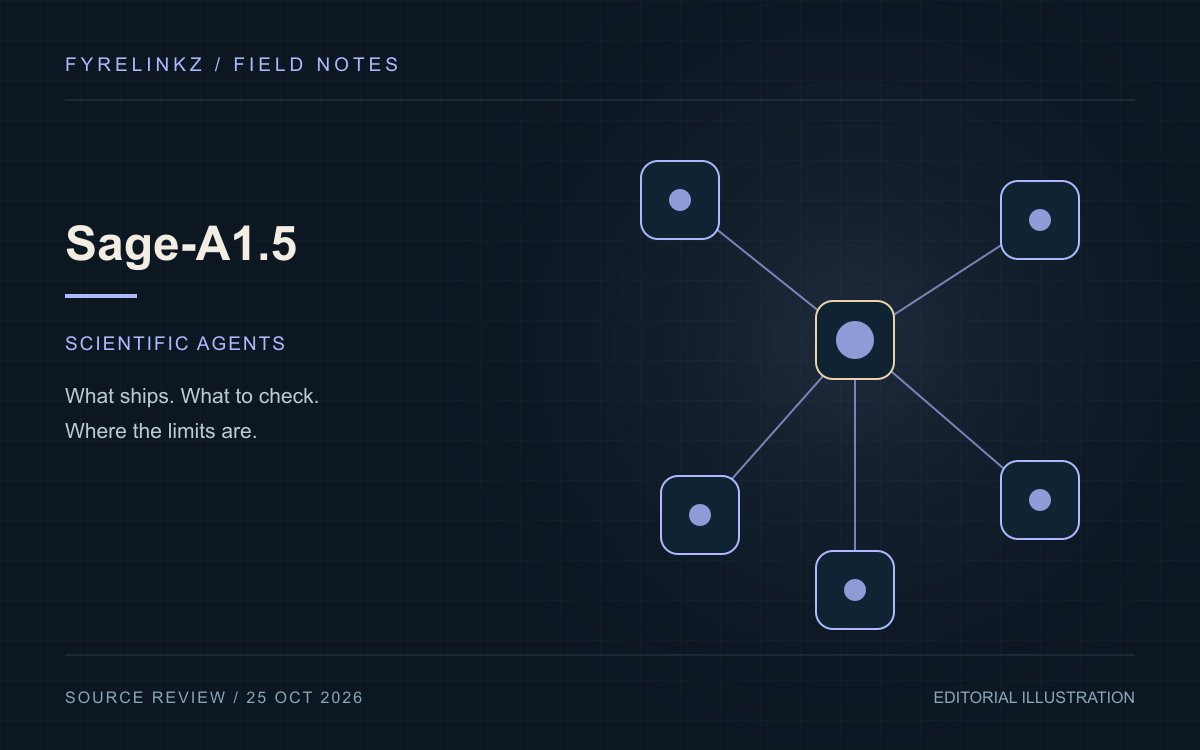
What Sage-A1.5 proposes
Alpha-Innovator describes a 35B mixture-of-experts model for engineering, search and scientific tasks, with parallel orchestration and optional internal verification. The project provides SGLang and vLLM serving examples under Alpha-Innovator/Agents-A1.5. Its benchmark tables are publisher-reported evaluations, not independent FyreLinkz measurements or proof of a new scientific discovery.
Start with inspectable evidence
For a first trial, use a small public dataset and a narrowly defined question with a known baseline. Require input identification, saved analysis code and the exact files needed to reproduce the result. Ask for observations and hypotheses to be separated. A modest, reproducible result is more useful than a fluent report whose transformations and assumptions are missing. Keep the original data immutable so corrections remain traceable.
Self-review is a hypothesis to test
Compare the same task with internal verification enabled and disabled under similar budgets. Blind final review where possible and score factual support, calculation accuracy and disclosure of failures. More self-critical prose is not a successful correction. The meaningful event is a verifiable error detected and repaired without introducing another unsupported claim. Check whether revisions improve the final artifact rather than merely increasing its length.
Local serving is one part of the system
The deployment showcase describes 35B total and 3B active parameters and several hardware routes. Its long-context setting is a configuration, not a minimum-memory guarantee. Active parameter count does not mean only those weights need memory. Measure complete runtime requirements, including context cache and tools, before promising workstation specifications or simultaneous-user capacity. Check the exact artifact and runtime version used.
Keep agent powers aligned with the task
Begin with read-only inputs and a bounded output directory. Add tools only when needed. Separate reading public evidence from changing a repository, submitting a job or sending a message. Log tool calls and returned evidence so a reviewer can distinguish computation from an unsupported narrative that computation occurred. These are proposed workflow controls, not a claim about default deployment behavior. Set a time and token budget before starting a long investigation.
Scientific usefulness has a higher bar
A useful outcome may be a rejected hypothesis or a reproducible negative result. Retain it instead of selecting only dramatic conclusions. Review the exact model card and dependency terms before redistribution; this article does not certify commercial permissions. No independent model benchmark is claimed. The practical decision is whether the system makes evidence easier to audit. A later comparison should include scripts, failed attempts and the assumptions that remained unresolved.
Measure the delivered work
Review a saved research task using a small checklist: were all requested outputs produced, do calculations rerun, are sources traceable and are unresolved assumptions clearly marked? Include the time a person spends checking the result. Do not reward a longer answer merely because it feels comprehensive. A shorter artifact with correct inputs and executable analysis may save more work than a polished report that requires substantial reconstruction.
Frequently asked questions
Can Sage-A1.5 be served locally?
The project links a model release and provides local SGLang and vLLM serving examples.
Does 3B active mean a 3B-sized memory requirement?
No. Total weights, context cache and runtime components also determine memory needs.
Does internal verification guarantee correct research?
No. Verify citations, rerun calculations and check that identified errors are actually corrected.
Sources & further reading
Primary sources checked Oct 25, 2026. Vendor statements are attributed; editorial advice is our own.
- 1Sage-A1.5 project and serving documentation ↗Alpha-Innovator
- 2Sage-A1.5 local deployment showcase ↗Alpha-Innovator
Help us keep this useful. Report a factual correction →