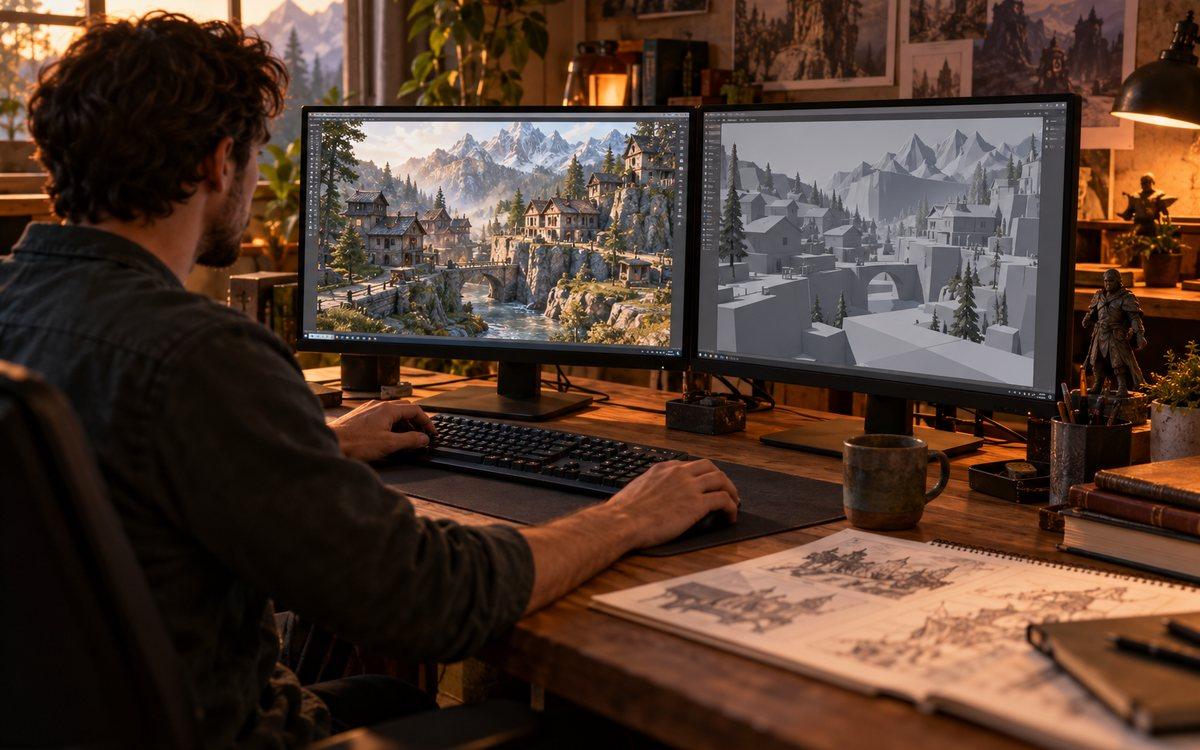
StreamRender-H3 reports a real-time streaming-rendering stack on substantial datacenter hardware. Its component timings should not be advertised as consumer-GPU performance or complete input-to-display latency.
What StreamRender-H3 actually reports
The project combines a coded game engine with a two-step streaming model built on MiniMax-H3. It reports roughly 218 ms diffusion rendering per streaming step on eight GB200 GPUs and a separate fast VAE measurement. Those are distinct components and configurations.
What this changes for the reader
Our main reading rule is to keep the timing boundary attached to every number. Rendering, decoding, control input, synchronization and display can have different clocks. A speedup against one baseline implementation does not reveal how much an entire interactive application improves.
A practical evaluation before adoption
Before attempting reproduction, inventory model assets, GPU topology and the full inference stack. For a latency review, record action arrival, engine update, render completion, decode and displayed frame. Report both steady operation and startup behavior. Use a simple repeatable control trace rather than a visually chosen highlight reel.
- Keep GPU count beside component timings.
- Separate diffusion, VAE and end-to-end delay.
- Confirm the released assets and underlying model license.
Limits and availability to keep in view
We have not run the eight-GPU configuration or measured concurrent sessions. The project does not establish that a laptop can reproduce its timing. A video showcase and a deployable runtime package answer different readiness questions.
Where to go next
Read our WorldPlay2 controls and deployment checks for the adjacent workflow decision. Keep this project's conditions separate from other models' results. If a dependency, artifact or service limit is unclear, leave it unresolved in the comparison rather than filling the gap with an assumption.
Frequently asked questions
Were the headline diffusion timings measured on one consumer GPU?
The cited project figure uses eight GB200 GPUs.
Is VAE decode time the same as full interactive latency?
No. Decode is one stage of the complete input-to-display path.
Has FyreLinkz independently tested StreamRender-H3?
No. This article reports the linked primary source and proposes an editorial evaluation; it contains no independent performance benchmark.
Sources & further reading
Primary sources checked Oct 18, 2026. Vendor statements are attributed; editorial advice is our own.
- 1StreamRender-H3 — primary source and release details ↗StreamRender-H3 project
Help us keep this useful. Check contact availability →