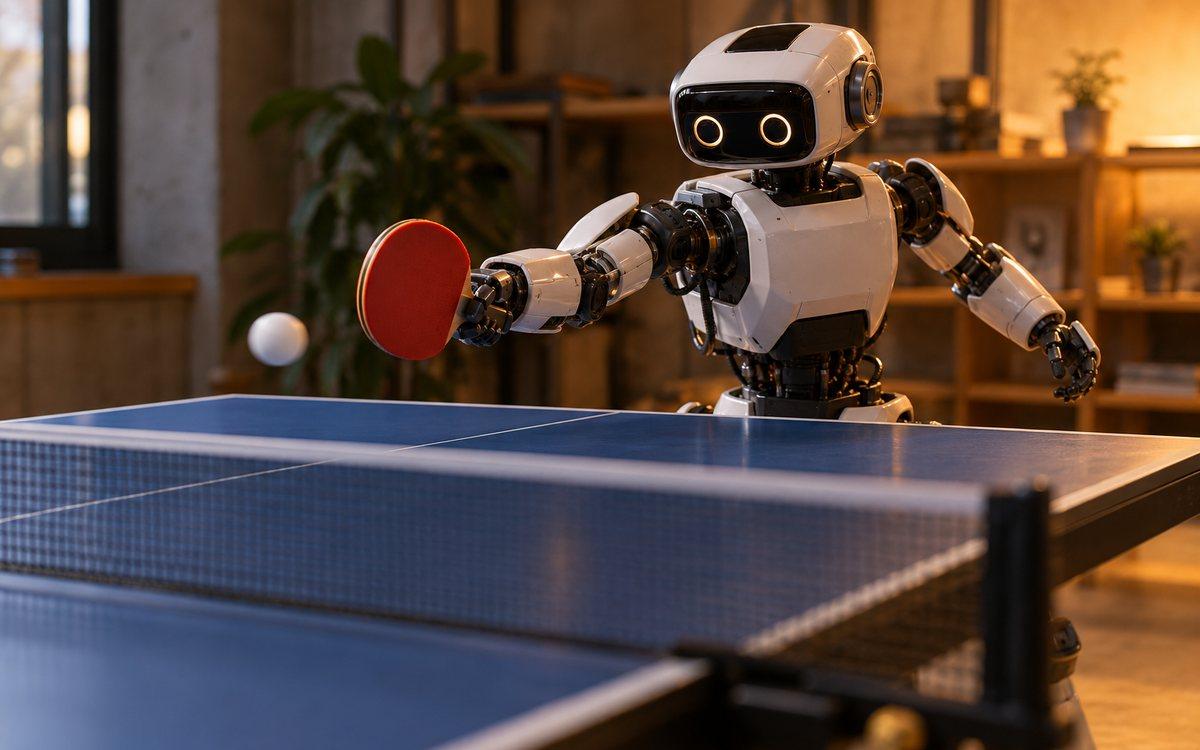
PingpongDuo studies two humanoids sharing a constrained table-tennis workspace. Its contribution includes coordination and transitions between moving and striking, not just hitting a stationary ball.
What PingpongDuo actually reports
The authors describe a team planner filtering risky positioning proposals, individual footwork and striking skills, and a residual controller refined with return feedback. The paper reports simulation comparisons and separate real-world movement and alternating-strike demonstrations.
What this changes for the reader
Doubles creates a conflict between reaching a ball and leaving room for a teammate. Our suggested interpretation distinguishes the planner's target selection, the robot's ability to reach it and the quality of the resulting strike. A return-rate improvement in simulation should stay attached to that simulator and baseline.
A practical evaluation before adoption
For a paper review, record which claims come from simulation and which have real-robot evidence. Track alternation, clearance and recovery rather than counting only successful returns. Ask how failed transitions, near collisions and interrupted rallies were recorded, and whether the tested layout matches the proposed use.
- Separate simulated results from physical demonstrations.
- Inspect strict alternation and teammate clearance.
- Keep failures and reset conditions in the evaluation.
Limits and availability to keep in view
We have not operated these robots or verified general match performance. A controlled demonstration does not establish safety around bystanders or robustness to arbitrary opponents. The original supplied project URL did not yield usable text, so this report cites the authors' arXiv paper.
Where to go next
Read our robot racket-sport research for the adjacent workflow decision. Keep this project's conditions separate from other models' results. If a dependency, artifact or service limit is unclear, leave it unresolved in the comparison rather than filling the gap with an assumption.
Frequently asked questions
Is PingpongDuo only a single-robot striking policy?
No. It explicitly studies team coordination and individual movement/striking skills for doubles.
Are simulation improvements automatically real-match results?
No. Keep simulated comparisons and physical demonstrations separate.
Has FyreLinkz independently tested PingpongDuo?
No. This article reports the linked primary source and proposes an editorial evaluation; it contains no independent performance benchmark.
Sources & further reading
Primary sources checked Oct 18, 2026. Vendor statements are attributed; editorial advice is our own.
- 1PingpongDuo — primary source and release details ↗PingpongDuo authors
Help us keep this useful. Check contact availability →